Global Shipping Lanes : The Strategic Straits That Control World Trade
Global trade depends heavily on maritime transport. Around 90% of traded goods move by sea, meaning that the stability of international shipping routes is essential to the global economy.
However, the world’s shipping network is surprisingly fragile. Much of global trade passes through a small number of narrow maritime chokepoints, strategic straits and canals that connect major oceans and trade routes. When conflict threatens these passages, the impact can ripple through energy markets, supply chains, and global logistics.
The current tensions involving Iran have once again highlighted the importance of these routes, particularly the Strait of Hormuz, one of the most geopolitically sensitive shipping lanes in the world.
Why the Strait of Hormuz Matters
The Strait of Hormuz, located between Iran and Oman, connects the Persian Gulf to the Arabian Sea and the wider Indian Ocean.
It is one of the most critical energy chokepoints on the planet:
• Around one-fifth of global oil consumption passes through the Strait of Hormuz, with roughly 20 million barrels of oil per day in transit through the strait. The majority of this oil is exported to Asian markets, including China, India, Japan and South Korea
• Significant volumes of liquefied natural gas (LNG) also transit the strait, particularly from Qatar, supporting energy and industrial production globally
• A key route for petrochemicals such as ethylene, polyethylene, and methanol – used in plastics, packaging, and food-grade materials
• Major exports of fertilisers (including urea and ammonia), which underpin global agricultural and food production systems
• Movement of sulphur and industrial minerals, widely used in fertiliser production and chemical processing
• Increasing volumes of containerised goods, including packaged food ingredients, additives, and raw materials
Recent conflict involving Iran has raised fears that shipping through the strait could be disrupted or blocked, which would have immediate consequences for global energy prices and supply chains.
- Ships have been struck and set on fire, following drone and projectile attacks on tankers and cargo vessels.
- Traffic has slowed sharply, with some periods where transit has come close to a standstill.
- Key energy infrastructure has been hit, adding further pressure to already fragile supply routes.
Because there are limited alternative routes for Persian Gulf oil exports, even partial disruption can significantly affect global markets.
The World’s Most Important Shipping Chokepoints
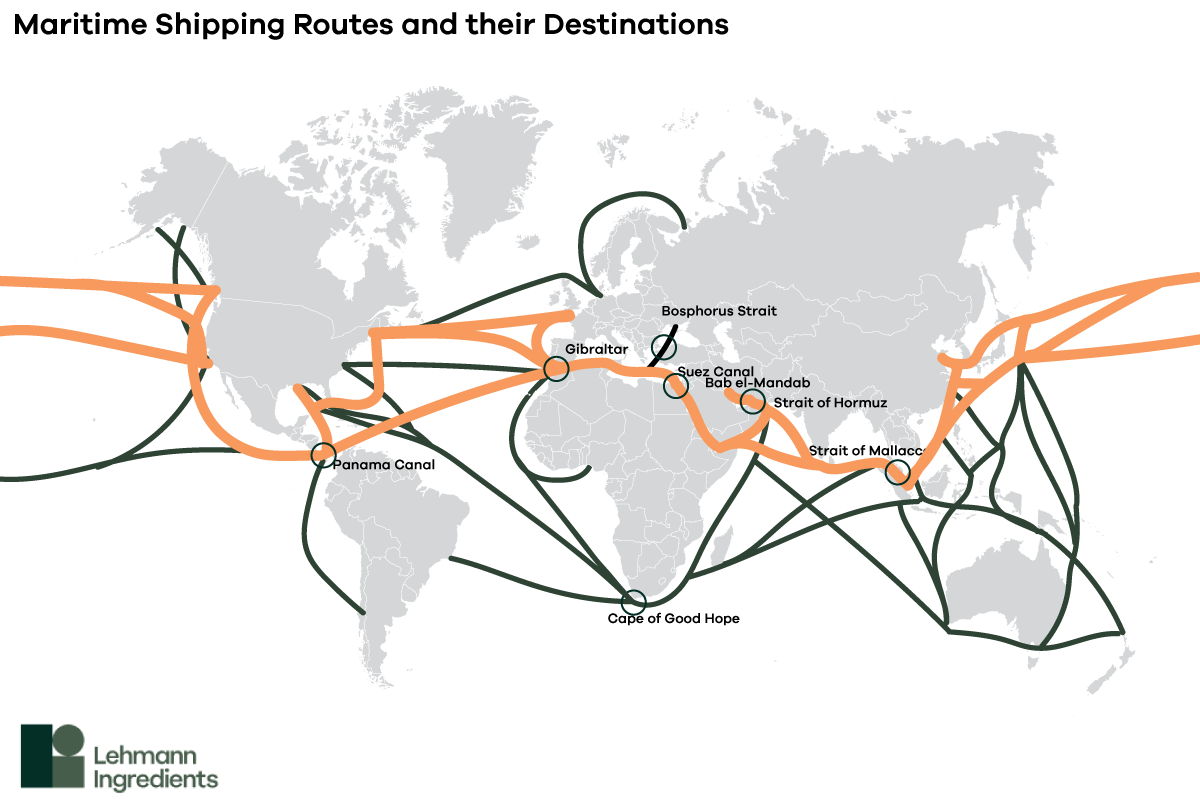
While the Strait of Hormuz is currently in focus, it is only one of several narrow passages that form the backbone of global trade.
In fact, more than 90% of seaborne oil trade flows through just a handful of maritime chokepoints worldwide.
Crucially, disruption in one route does not necessarily stop trade altogether; it often reshapes it. Shipping can be redirected through alternative corridors, such as around the Cape of Good Hope or via major hubs like the Strait of Malacca.
However, this flexibility comes at a cost:
• Longer routes increase transit times, fuel usage, and freight rates.
• Congestion can build quickly in alternative chokepoints, creating secondary bottlenecks.
• Countries or regions controlling key routes may gain pricing power or strategic advantage during periods of disruption.
• In some cases, trade flows can shift in ways that benefit alternative corridors commercially; for example, increased reliance on the Strait of Malacca if Middle Eastern routes become constrained.
So while there is resilience built into the global shipping network, it is not without consequence. The system adapts, but often with higher costs, longer lead times, and increased volatility for global supply chains.
Starting with Strait of Hormuz, the most important include:
1. Strait of Hormuz (Middle East)
Location: Between Oman and Iran
Connects: Persian Gulf → Arabian Sea
Key facts:
• Critical for global energy flows, but also supports movement of petrochemicals used in plastics, packaging, and food processing.
• Major route for fertilisers (urea, ammonia) produced in the Gulf and exported globally.
• Disruption impacts resins, solvents, and additives used across food, pharma, and personal care.
• Even short-term instability can drive sharp cost increases across ingredient supply chains.
2. Strait of Malacca (Southeast Asia)
Location: Between Malaysia, Singapore, and Indonesia
Connects: Indian Ocean → South China Sea
Key facts:
• One of the world’s busiest trade corridors for containerised goods, including food ingredients and finished products.
• Key route for palm oil, a core ingredient in food manufacturing, as well as oleochemicals.
• High volumes of speciality chemicals, additives, and nutraceutical ingredients move between Asia and Europe.
• Congestion or disruption quickly impacts lead times and availability of imported ingredients.
3. Bab el-Mandeb Strait (Red Sea)
Location: Between Yemen and Djibouti/Eritrea
Connects: Red Sea → Gulf of Aden → Indian Ocean
Key facts:
• Critical gateway to the Suez Canal, linking Europe with Asia.
• Major route for containerised food ingredients, including spices, rice, and processed goods.
• Handles significant volumes of fertilisers, polymers, and industrial chemicals.
• Recent instability has forced rerouting via the Cape of Good Hope, increasing cost and lead times.
4. Suez Canal (Egypt)
Location: Egypt
Connects: Mediterranean Sea → Red Sea
Key facts:
• One of the world’s most important shipping shortcuts between Europe and Asia
• Vital for bulk ingredients such as grains, sugar, and vegetable oils moving into Europe.
• High volumes of food additives, flavourings, and speciality chemicals transit through this route.
• Disruption in the Suez Canal has historically been rare, but an ongoing armed conflict in the Red Sea with Yemeni Houthi rebels targeting ships with drones and missile attacks has of course had a significant impact upon shipping with many carriers opting to sail via the Cape of Good Hope. The longer route placing pressure upon supply chain availability, pricing, and production planning. There have been discussions of ceasefire, but as of today tensions remain high.
5. Panama Canal (Central America)
Location: Panama
Connects: Atlantic Ocean → Pacific Ocean
Key facts:
• Critical for trade between Asia, the Americas, and Europe.
• One of the world’s most important interoceanic shipping shortcuts.
• Key route for agricultural commodities, including maize, soy, and animal feed ingredients.
• Facilitates movement of food-grade chemicals, sweeteners, and processing aids between global markets.
• Water level constraints and congestion can delay ingredient shipments and increase freight costs.
6. Cape of Good Hope (South Africa)
Location: South Africa
Connects: Atlantic Ocean → Indian Ocean
Key facts:
• Major alternative route when the Suez Canal is disrupted.
• Widely used for bulk agricultural commodities such as grains, sugar, and oilseeds moving between Europe, Asia, and the Americas.
• Key route for chemical cargoes and fertilisers, particularly when Red Sea routes are unstable.
• Adds significant time and cost, increasing freight rates for food ingredients and raw materials.
7. Strait of Gibraltar (Europe/Africa)
Location: Between Spain and Morocco
Connects: Atlantic Ocean → Mediterranean Sea
Key facts:
• One of the busiest maritime chokepoints linking Europe to global shipping routes.
• Essential for processed food ingredients, additives, and packaged goods moving into and out of Europe.
• High volumes of speciality chemicals and pharmaceuticals transit through this corridor.
• Acts as a gateway to the Suez Canal, making it critical for Europe–Asia ingredient supply chains.
8. Bosphorus Strait (Turkey)
Location: Turkey
Connects: Black Sea → Sea of Marmara → Mediterranean Sea
Key facts:
• Critical for exports of grains, sunflower oil, and other edible oils from the Black Sea region.
• Major route for fertilisers and agricultural inputs, supporting global food production.
• Handles significant volumes of bulk chemicals and industrial raw materials.
• Narrow, high-traffic waterway – delays can quickly impact ingredient availability and pricing.
Why These Straits Are So Vulnerable
These shipping lanes are called chokepoints because of their geography. They are narrow maritime passages that concentrate large volumes of global trade into relatively small corridors. In many cases, thousands of vessels pass through these straits each year, creating critical bottlenecks where even a small disruption can have outsized consequences for global supply chains.
- Their vulnerability comes from several factors. First, the geography of these passages means there are often few practical alternatives. If a chokepoint is disrupted, ships may be forced to take much longer routes, adding significant time and cost.
- Second, many of these straits sit in politically sensitive regions, where conflict, piracy, or regional tensions can threaten shipping.
- Finally, the large volumes of global trade passing through these narrow corridors mean that even short disruptions can quickly impact supply chains, increasing freight costs and pushing up commodity prices.
Because of this, they represent strategic leverage in geopolitical conflicts.
For example:
• The closing of Hormuz has resulted restrict Gulf oil exports.
• Disrupting Bab el-Mandeb could block access to the Suez Canal.
• Attacks in the Red Sea can reroute shipping around Africa.
Each scenario significantly increases shipping time, freight costs, insurance premiums, and commodity prices.
The Global Economic Impact
When shipping lanes become unstable, the consequences extend far beyond the region of conflict.
Potential effects include:
• Rising oil and gas prices.
• Higher shipping and insurance costs.
• Delays in global supply chains.
• Disruptions to manufacturing and retail logistics.
Because maritime transport underpins the global economy, instability in a single chokepoint can trigger widespread economic consequences.
How Shipping Disruptions Impact Global Food Ingredient Supply Chains
Global food supply chains rely heavily on the same shipping routes to transport raw materials, processed ingredients, and finished products between continents.
Many widely used food ingredients are traded internationally. Products such as vegetable oils, starches, sweeteners, proteins, spices, and food additives are often produced in one region and shipped to manufacturers around the world. When shipping lanes are disrupted, transit times increase and freight capacity becomes constrained, which can delay deliveries and increase transportation costs.
For example, ingredients moving between Asia, the Middle East, and Europe often pass through routes such as the Suez Canal or Bab el-Mandeb Strait. If vessels are forced to reroute around Africa, journeys can become significantly longer, increasing fuel costs, insurance premiums, and freight rates.
Two recent events illustrate just how fragile these routes can be: the 2021 grounding of the container ship Ever Given in the Suez Canal during the Suez Canal obstruction, which blocked the canal for six days and created a massive backlog of queued vessels, and the more recent Red Sea crisis around the Bab el‑Mandeb Strait, where attacks on commercial shipping forced many carriers to reroute around Africa; both highly publicised incidents that quickly triggered global supply-chain anxiety.
Consequently, these disruptions can create several challenges for food manufacturers and ingredient suppliers:
- Longer lead times for raw materials and ingredients.
- Higher freight costs, which feed into ingredient pricing.
- Supply uncertainty, particularly for globally sourced commodities.
- Inventory pressure, as companies hold more stock to manage risk.
For ingredient suppliers and manufacturers alike, geopolitical tensions around major shipping chokepoints highlight the importance of diversified sourcing, resilient logistics planning, and strong supply chain visibility to maintain continuity in global food production.
Products that are often affected include globally traded commodities such as starches, sweeteners, fibres, hydrocolloids, plant proteins, and food additives, particularly when they are sourced from Asia or other long-distance supply regions. In periods of disruption, demand for specific ingredients can temporarily outstrip available supply, putting upward pressure on prices across the market.
For customers, this is where working with an experienced ingredient distributor can make a significant difference. At Lehmann Ingredients, we manage the complexity of international sourcing and import logistics on behalf of our customers. By working with established global supply partners, maintaining forward purchasing strategies, and managing inventory within the UK and Europe, we help reduce the risks that can arise when buying directly from overseas exporters.
This is particularly important for widely traded commodities such as soy, where production is highly concentrated. Around 90% of global soybean supply comes from just six countries; Brazil, the United States, Argentina, China, Paraguay, and India; meaning regional weather events, infrastructure constraints, or geopolitical tensions can quickly impact global availability.
Our approach helps balance this exposure. By sourcing across multiple origins and holding stock closer to our customers, we reduce reliance on any single supply route or harvest cycle. This helps provide more reliable availability and greater price stability, insulating manufacturers from some of the volatility that can occur in global freight and commodity markets.
However, when major shipping disruptions occur, such as delays through key trade routes or extended transit times, these pressures can eventually affect the entire market. Freight rates may rise, lead times can extend, and demand for certain ingredients can increase rapidly as manufacturers secure supply.
Conclusion
The Iran conflict has once again highlighted the fragile geography of global trade. Despite advances in logistics and technology, much of the world’s commerce still depends on a handful of narrow maritime corridors. The Strait of Hormuz, along with other strategic passages such as Malacca, Bab el-Mandeb, Suez, and Panama, functions as the critical infrastructure of global shipping.
As geopolitical tensions rise in several regions simultaneously, the stability of these routes will remain one of the most important factors shaping global trade, energy markets, and supply chain resilience. By actively managing sourcing relationships, logistics planning, and inventory buffers, Lehmann Ingredients aims to help customers navigate these challenges and maintain a more stable supply environment, even when global shipping conditions become uncertain.