
Across many categories, businesses are under increasing pressure to reduce sodium levels while maintaining the taste, texture, and functionality that consumers expect.
This pressure is coming from several directions. Governments have introduced sodium reduction targets and reformulation programmes aimed at improving public health, while major retailers are increasingly setting their own nutrition standards for both private label and branded products. Front-of-pack labelling schemes also make salt levels more visible to consumers, influencing purchasing decisions and brand perception.
In the UK in particular, salt reduction is closely linked to HFSS (High Fat, Salt and Sugar) regulations. Products classified as HFSS can face restrictions on promotion and placement in retail environments, including limits on prominent store locations and certain marketing activities. For manufacturers, reducing salt can therefore play a role in improving a product’s overall nutritional profile and helping brands remain competitive within a tightening regulatory landscape.
As a result, salt reduction is not simply a trend to respond to; it is a product development challenge. Reformulation must balance sodium reduction with the technical functions salt provides, ensuring that flavour, texture, shelf life, and overall product performance are maintained.

Why Salt Matters in Food Manufacturing
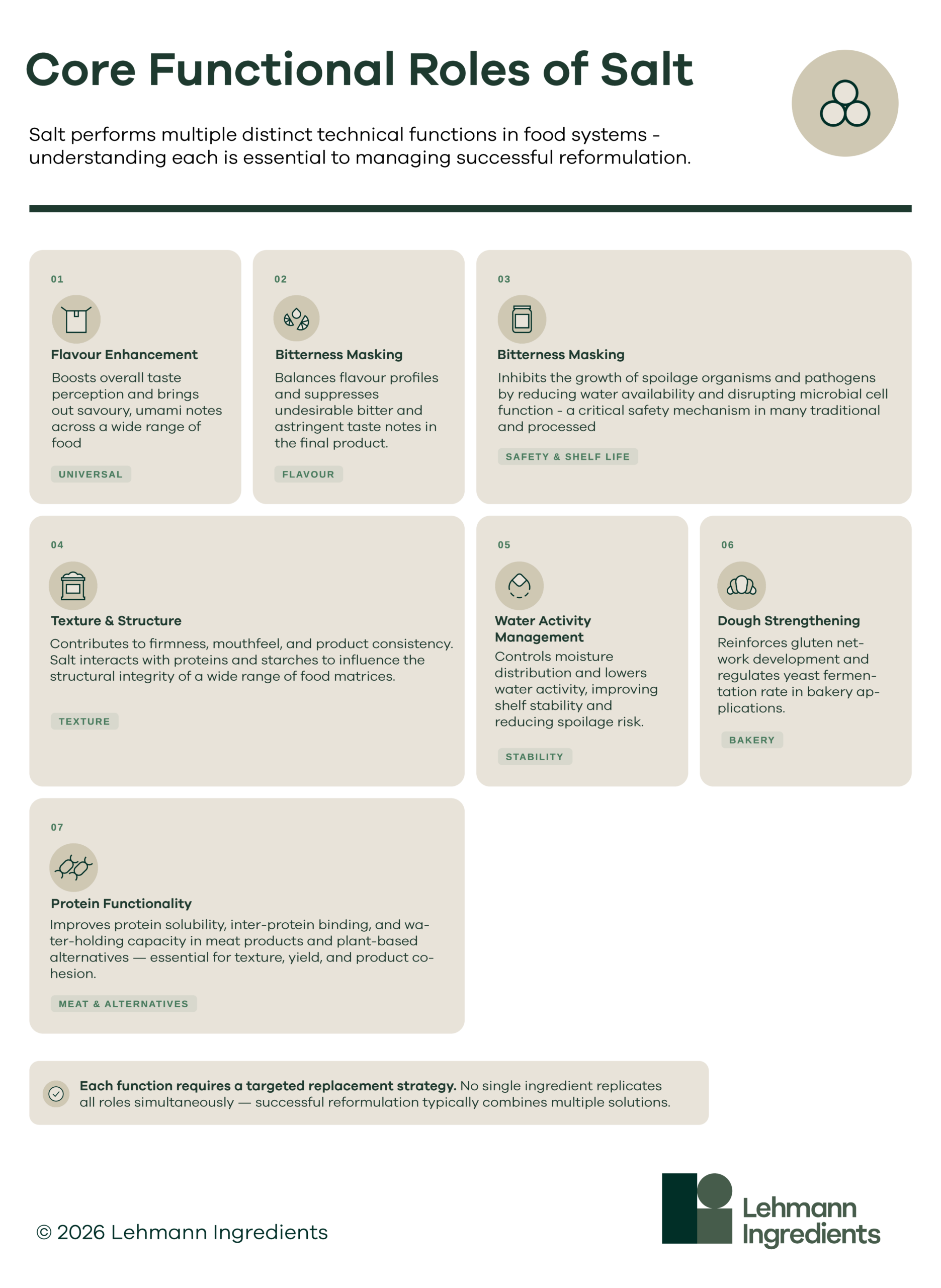
Before considering how to reduce salt, it is important to understand why it is widely used in food formulations in the first place. Salt performs several critical technical functions in food manufacturing that go far beyond simply adding flavour. In many products, it contributes to product safety, stability, processing performance, and overall eating quality.
The Manufacturing Challenge: Why Salt Reduction Is Difficult
Reducing salt in food products can be technically complex because salt contributes to multiple aspects of product performance. Simply lowering the salt level in formulation can lead to noticeable changes in flavour, texture, stability, and processing behaviour, making reformulation a careful balancing exercise for manufacturers.

Common challenges include:
- Flavour loss and a flatter taste profile as salt levels decrease
- Reduced consumer acceptance, particularly in products where a savoury taste is expected
- Changes in texture and mouthfeel, which can affect product quality and eating experience
- Shelf-life considerations, as salt helps control microbial growth and product stability
- Processing changes, including impacts on hydration, fermentation, and overall formulation stability
As a result, reducing it is not simply about removing an ingredient; it usually requires replacing or compensating for the functional roles salt provides.

Current Industry Pressures and Reformulation Drivers
Salt reduction in food products is increasingly influenced by a range of regulatory, commercial, and market factors. For manufacturers, reformulation is often driven not only by nutrition policy but also by retailer expectations and broader shifts in consumer awareness around health.
Several key pressures are shaping salt reduction strategies across the food industry:
- UK and EU salt reduction initiatives aimed at improving public health and encouraging gradual reformulation across key food categories, such as HFSS regulations and wider nutrition reformulation strategies, which encourage manufacturers to improve overall product nutritional profiles
- Retailer nutrition targets,to align with WHO sodium benchmarksa, many supermarkets have been setting category-specific sodium benchmarks for both private label and branded products
- Brand reputation and health positioning, as consumers increasingly look for products that support healthier dietary choices
Together, these factors are making salt reduction an important consideration in product development, particularly for manufacturers looking to maintain market access, meet retailer requirements, and align with evolving health and nutrition expectations.
Practical Strategies for Salt Reduction
Reducing salt in food products often requires a combination of formulation techniques rather than relying on a single replacement ingredient. We’ve touched on how reformulation strategies typically focus on maintaining flavour, texture, and product performance while gradually lowering sodium levels. Let’s explore further.
Stepwise Reduction
Gradually lowering salt levels over time can help minimise noticeable changes in flavour.
- Small, incremental reductions allow consumers to adapt without experiencing a sudden change in taste.
- Salt formats that deliver strong flavour perception at lower usage levels can also support gradual reduction strategies. For example, ingredients such as Alberger Salt provide a light, flake structure that dissolves quickly and can enhance salt perception, allowing formulators to reduce overall sodium while maintaining flavour impact.
Flavour Optimisation
Adjusting flavour balance is often the most effective way to compensate for reduced salt levels.
- Acidity balance can enhance brightness and overall flavour perception. Ingredients such as Citric Acid or Vinegar can help sharpen flavour profiles and increase perceived saltiness in reduced-sodium formulations.
- Umami ingredients can boost savoury depth and complexity. For example, Monosodium Glutamate is widely used to enhance savoury taste, helping products maintain a full flavour profile even when salt levels are reduced.
- Herbs and spices can add additional flavour layers that offset lower sodium levels.
Salt Substitutes
Salt substitutes are commonly used to partially replace sodium chloride while maintaining functional performance.
- Potassium Chloride is one of the most widely used sodium-reduction ingredients, offering a similar functional profile to salt in many applications.
- Blended solutions that combine potassium chloride with traditional salt to help reduce sodium while maintaining a familiar flavour profile.
- In some cases, taste masking considerations may be needed to manage the slight bitterness that can occur with higher potassium chloride inclusion levels.
Functional Ingredient Support
Salt reduction can influence texture, stability, or processing performance, so the addition of other functional ingredients can mitigate and such degradation.
- Starches and fibres can help maintain mouthfeel and body in reduced-sodium formulations.
- Protein systems can support structure and texture where salt previously contributed to protein functionality.
- Emulsifiers may be useful where salt reduction affects emulsion stability in products such as sauces, dressings, or prepared foods.

By combining flavour optimisation, salt substitutes, and functional ingredient support, manufacturers can achieve meaningful sodium reductions while maintaining the taste, texture, and overall product performance that consumers expect.
Category-Specific Considerations
Salt reduction strategies can vary significantly depending on the product category. Because salt contributes in different ways across applications, reformulation approaches often need to be tailored to the specific characteristics of each product.
Bakery
- Impact on gluten strength and dough handling, as salt helps reinforce gluten networks
- Fermentation control, influencing yeast activity and proofing behaviour
- Crumb structure effects, where lower salt levels can affect texture and overall product consistency
Snacks
- Surface vs internal salt strategies, with many snack products relying on surface seasoning for flavour delivery
- Particle size and salt distribution, which can influence how salty a product tastes even at lower sodium levels
- Perception management, using seasoning blends to maintain flavour impact
Sauces and Dressings
- Emulsion stability, as salt can influence ingredient interactions within emulsified systems
- Acid and flavour balancing, where adjustments to acidity, sweetness, or seasoning may be needed
- Overall flavour layering to maintain taste complexity with reduced sodium
Meat and Plant-Based Products
- Water binding, as salt contributes to moisture retention and product yield
- Protein extraction and functionality, which supports binding and structural integrity
- Texture retention, ensuring the final product maintains the expected bite and mouthfeel despite lower salt levels

Salt Reduction Without Compromising Consumer Experience
While nutrition targets and regulatory pressures are important drivers, consumer acceptance remains the ultimate test of any reformulated product. Regardless of health positioning, taste is still the deciding factor in repeat purchase and long-term product success.
Salt contributes significantly to the overall eating experience, influencing not only flavour but also mouthfeel, balance, and perceived indulgence. When sodium levels are reduced, these sensory elements must still be preserved to ensure that the product continues to meet consumer expectations.

Today’s consumers are increasingly interested in healthier options, but they generally do not want to feel that they are compromising on enjoyment. Products that successfully balance improved nutritional profiles with satisfying taste and texture are far more likely to succeed in the marketplace.
Ultimately, the most effective reformulation strategies are those where the change is almost imperceptible to the consumer. Successful salt reduction is often the kind that happens quietly; maintaining the same enjoyable eating experience while gradually improving the product’s nutritional profile.
Ingredients That Support Salt Reduction
While sodium reduction focuses on lowering salt levels, supporting ingredients can play an important role in ensuring the final product continues to meet both technical and sensory expectations.
These ingredients typically support reformulation in three key areas: flavour support, texture retention, and stability improvement.
Common ingredient solutions include:
- Flavour enhancers - help build savoury depth and support flavour perception in reduced-salt products
- Functional fibres - contribute to mouthfeel and help maintain product body and structure
- Starches - support texture, viscosity, and moisture management in many formulations
- Proteins - assist with binding, structure, and overall texture in both meat and plant-based products
- Hydrocolloids - help stabilise systems, manage water, and maintain product consistency
- Emulsifiers - stability in sauces, dressings, and prepared foods to balance ingredient interactions
How Manufacturers Approach Reformulation
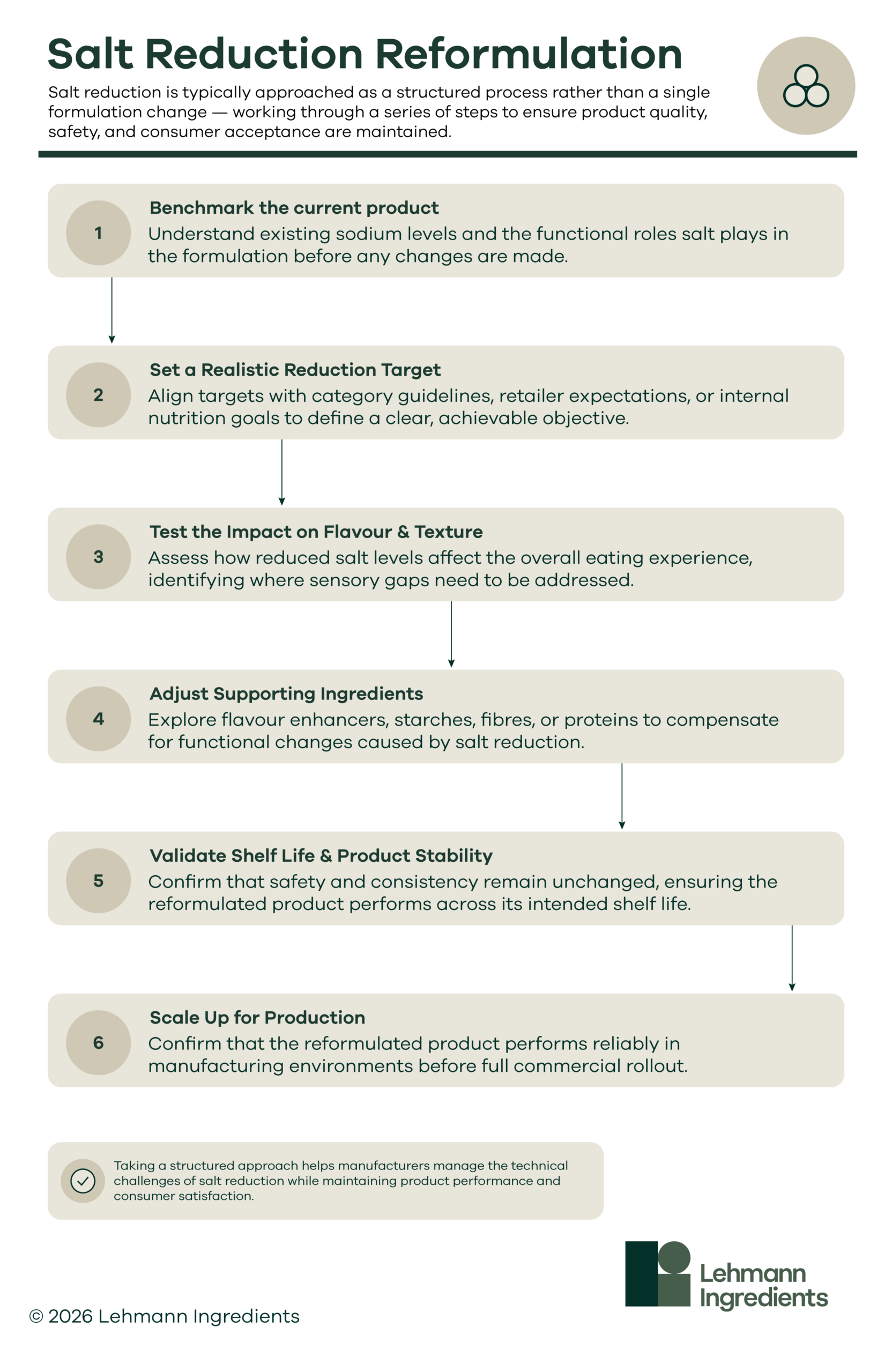
Salt reduction is typically approached as a structured reformulation process rather than a single formulation change. Manufacturers often work through a series of steps to ensure that product quality, safety, and consumer acceptance are maintained.

A typical workflow may include:
- Benchmarking the current product to understand existing sodium levels and functional roles in the formulation
- Setting a realistic reduction target, often aligned with category guidelines, retailer expectations, or internal nutrition goals
- Testing the impact on flavour and texture to assess how reduced salt levels affect the overall eating experience
- Adjusting supporting ingredients such as flavour enhancers, starches, fibres, or proteins to compensate for functional changes
- Validating shelf life and product stability to ensure safety and consistency remain unchanged
- Scaling up for production, confirming that the reformulated product performs reliably in manufacturing environments
Salt Reduction: An Ongoing Formulation Strategy
Salt reduction is no longer a one-off reformulation exercise – it is becoming a continuous part of product development. As consumer expectations around health and nutrition continue to evolve, alongside retailer requirements and regulatory pressure, manufacturers are increasingly expected to review and optimise formulations over time.

This presents a fundamental challenge. Salt is not just a seasoning; it is fundamental to both functional and sensory performance. Reducing it therefore impacts multiple aspects of a product simultaneously, meaning successful reformulation must carefully balance:
- Taste
- Texture and mouthfeel
- Stability and shelf life
- Nutritional profile
Achieving this balance requires more than simple substitution. It often involves combining flavour optimisation, salt reduction strategies, and functional ingredient support to maintain product quality and consumer acceptance.
Looking ahead, multi-functional ingredients will play an increasingly important role – particularly those that can support flavour, structure, and stability at the same time. These solutions enable manufacturers to reduce sodium while maintaining performance across increasingly complex formulations.

How We Can Help
At Lehmann Ingredients, we support manufacturers through every stage of salt reduction – from initial concept through to reformulation and scale-up. By combining functional ingredient solutions with technical expertise, we help maintain product performance while meeting sodium reduction targets.
If you’re exploring salt reduction in your formulations, we can help you identify practical solutions that deliver on both performance and nutritional goals.
FAQ Section
What is salt reduction in food manufacturing?
Salt reduction refers to the process of lowering the sodium content in food products while maintaining flavour, texture, shelf life, and overall product performance. This typically involves a combination of strategies such as gradual sodium reduction, flavour optimisation, salt substitutes, and the use of functional ingredients that help maintain product quality.
What foods are surprisingly high in sodium?
Some foods that do not taste particularly salty can still contain significant sodium levels due to their functional formulation needs. Examples include:
- Bread and baked goods
- Breakfast cereals
- Processed plant-based products
- Ready-made sauces and dressings
- Sandwich fillings and deli meats
In these products, salt often plays a role in texture, fermentation control, and preservation, making reduction technically challenging.
What is the UK salt reduction programme?
The UK salt reduction programme is a long-standing public health initiative aimed at lowering population sodium intake through category-specific reformulation targets for food manufacturers. Led by Public Health England (now under Office for Health Improvement and Disparities), the programme encourages the gradual reduction of salt across commonly consumed food categories via voluntary industry action.
This approach increasingly converges with HFSS (High Fat, Salt and Sugar) regulations, where sodium levels contribute to nutrient profiling scores that determine product eligibility for promotion and placement. As a result, salt reduction is no longer just a public health objective – it has become a commercial and regulatory consideration for manufacturers operating in the UK market.
The programme focuses on food categories such as:
- Bread and baked goods
- Processed meats
- Sauces and soups
- Ready meals
- Snack foods
These targets are regularly reviewed and updated to support gradual reductions across the food supply.
Why is salt reduction important for food manufacturers?
Salt reduction has become an important part of product development due to several industry drivers:
- Public health initiatives aimed at reducing sodium intake
- Retailer nutrition policies and category targets
- HFSS regulations affecting product promotion and placement
- Growing consumer demand for healthier food options
For manufacturers, this means balancing nutritional improvements with flavour, texture, and product stability.
How do manufacturers reduce sodium without affecting flavour?
Manufacturers typically reduce sodium using a combination of strategies rather than removing salt entirely. These include gradual salt reduction, flavour optimisation using umami ingredients, yeast extracts, and acids, as well as salt substitutes such as potassium chloride blends. Supporting ingredients can also help maintain texture and mouthfeel when sodium levels are lowered.
What ingredients can replace salt in food formulations?
There is no direct one-to-one replacement for salt because it performs multiple functions. However, ingredients commonly used to support salt reduction include:
- Potassium chloride blends
- Yeast extracts
- Umami ingredients
- Functional fibres
- Starches
- Hydrocolloids
- Proteins and emulsifiers
These ingredients help maintain flavour, structure, and product stability.
How does salt affect water activity in food?
Salt lowers water activity by binding free water in food systems. This reduces the amount of water available for microbial growth, helping to extend shelf life and improve product safety. Because of this, salt reduction strategies must often consider alternative ways to manage water activity.
What is stepwise salt reduction?
Stepwise salt reduction involves gradually lowering sodium levels over time rather than making large formulation changes at once. This allows consumers to adapt to slightly lower salt levels without noticing a major change in flavour.
Does salt reduction affect shelf life?
Yes. Because salt contributes to preservation and microbial control, reducing sodium may impact shelf life. Manufacturers often address this through reformulation strategies that adjust water activity, acidity, or other preservation methods.
What is the difference between sodium reduction and salt reduction?
Salt reduction typically refers to lowering sodium chloride (NaCl) in a product. Sodium reduction may involve broader strategies that reduce sodium from all sources, including sodium–based additives.