
HACCP is one of the most widely referenced terms in food safety, yet it is frequently used loosely, sometimes interchangeably with certification schemes that are not the same thing. Understanding what HACCP actually is, how it works in practice, and where it sits within the broader food safety landscape is useful for anyone working in food manufacturing, ingredient sourcing, or supply chain management.
This guide covers the seven principles of HACCP, the types of hazard it addresses, who is required to have it in place, and how it connects to the certification schemes buyers encounter when approving suppliers.
What is HACCP?
HACCP stands for Hazard Analysis and Critical Control Points. It is a systematic, science-based approach to identifying, evaluating, and controlling food safety hazards throughout the food production process.
It was developed in the late 1960s by the Pillsbury Company, working alongside NASA and the US Army Laboratories. The original goal was to produce microbiologically safe food for space missions, where end-product testing alone could not guarantee safety and the consequences of failure were severe. That same logic, controlling hazards at the point where they occur, rather than testing for them afterwards, proved equally valuable in commercial food production.
The Codex Alimentarius Commission, a joint body of the Food and Agriculture Organization (FAO) and the World Health Organization (WHO), formalised the system in guidelines first published in 1993 and subsequently revised. Those guidelines formed the basis for HACCP requirements now embedded in food safety legislation across the UK, European Union, United States, and most other major markets. In the UK, food hygiene legislation requires food business operators to implement and maintain hygiene procedures based on HACCP principles, a requirement retained in UK law following Brexit.
HACCP is not a certification scheme. It is a structured way of thinking about and controlling the risks within a food production or handling process. Many certification schemes, including those recognised by GFSI, require it as a foundational element of a supplier’s food safety management system.

The Seven Principles of HACCP
HACCP is structured around seven principles, applied sequentially to develop a food safety management plan for a specific product or process. The table below summarises each principle and what it involves in practice.
| # | Principle | What it involves |
| 1 | Conduct a hazard analysis | Identify all potential biological, chemical, physical, and allergenic hazards. Assess likelihood and severity of each. |
| 2 | Identify critical control points | Determine the specific process steps where control measures can prevent, eliminate, or reduce a hazard to an acceptable level. |
| 3 | Establish critical limits | Set measurable maximum or minimum values (temperature, pH, time, water activity) at each CCP. |
| 4 | Establish monitoring procedures | Define how each CCP is monitored, at what frequency, and by whom, to detect loss of control in time to act. |
| 5 | Establish corrective actions | Define what happens when a CCP goes out of control; what is done to affected product and how the process is corrected. |
| 6 | Establish verification procedures | Confirm the HACCP system is working effectively through record reviews, product testing, and CCP audits. |
| 7 | Establish documentation and record-keeping | Maintain records covering hazard analysis, CCPs, critical limits, monitoring results, corrective actions, and verification activities. |
The seven principles are applied within a broader HACCP study that also includes preliminary steps; defining the scope, assembling the HACCP team, describing the product, and constructing a process flow diagram for verification.
The Four Types of Food Hazard
The hazard analysis at the core of HACCP considers four categories of food safety hazard. The table below summarises each category, with examples and the types of control measure typically applied.
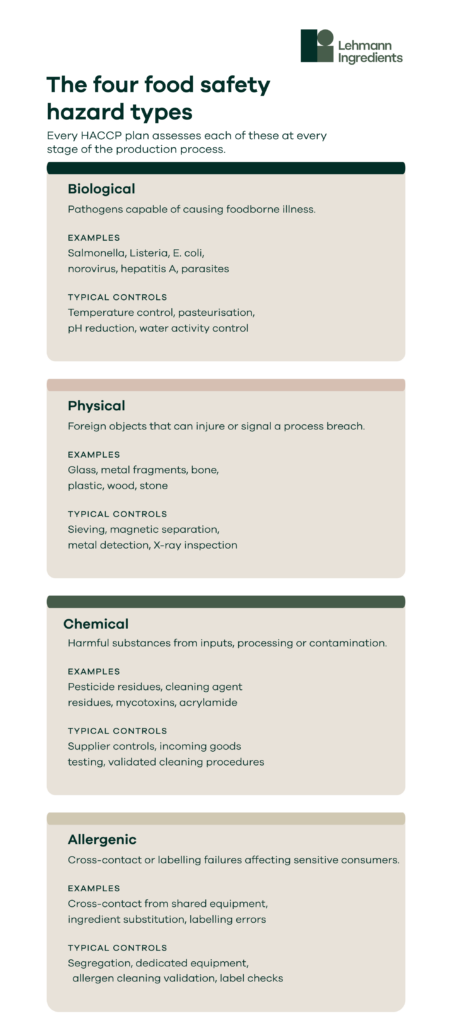
| Hazard type | Examples | Typical control measures |
| Biological | Pathogenic bacteria (Salmonella, Listeria, E. coli), viruses (norovirus, hepatitis A), parasites | Temperature control, pasteurisation, pH reduction, water activity control |
| Chemical | Pesticide residues, cleaning agent residues, mycotoxins, processing contaminants such as acrylamide | Supplier controls, incoming goods testing, process controls, validated cleaning procedures |
| Physical | Glass, metal fragments, bone, plastic, wood, stone | Sieving, magnetic separation, metal detection, X-ray inspection |
| Allergenic | Cross-contact from shared equipment or facilities, ingredient substitution, labelling errors | Segregation, dedicated equipment, allergen cleaning validation, label verification |
Who Needs HACCP?
In the UK and European Union, food business operators are legally required to implement and maintain hygiene procedures based on HACCP principles. This applies to any business involved in the production, processing, handling, distribution, storage, or supply of food for human consumption.
The practical scope is broad. It covers manufacturers, processors, packers, distributors, ingredient suppliers, and cold store operators. Primary producers; farms and growers, are subject to separate requirements under general hygiene regulations rather than the full HACCP-based requirements, though many choose to implement HACCP voluntarily or are required to by their customers.
There is no universal HACCP certification in the way that there is for BRCGS or FSSC 22000. HACCP is a legal requirement and an operational methodology. What buyers will often ask for is evidence that a supplier has a documented, implemented, and verified HACCP plan in place; typically through audit documentation, third-party certification under a scheme that requires HACCP, or a completed supplier questionnaire.

HACCP in Ingredient Manufacturing
For ingredient manufacturers and suppliers, HACCP goes beyond compliance. A well-designed HACCP plan reflects a detailed understanding of the product, the raw materials, the process, and the end use; and that understanding directly informs how safely and consistently an ingredient can be produced.
In ingredient manufacturing, some of the most commonly identified critical control points involve thermal treatment such as pasteurisation, drying, or extrusion where pathogen reduction is achieved; metal detection and foreign body removal; and moisture or water activity control for shelf-stable products.
Hazard analysis in ingredient manufacturing also needs to account for the downstream use of the ingredient. An ingredient supplied for use in ready-to-eat applications requires tighter control than one intended for further processing with a validated kill step. Suppliers should understand how their ingredient will be used and ensure their HACCP plan reflects the appropriate level of control for that application.
When sourcing ingredients for ready-to-eat applications, it is worth confirming with your supplier that their HACCP plan specifically addresses the hazards relevant to that end use, rather than assuming a general food safety certification covers all scenarios.
HACCP and GFSI-Recognised Schemes
HACCP is the methodological foundation on which every major food safety certification scheme is built. BRCGS, FSSC 22000, SQF, IFS Food, and all other schemes recognised by the Global Food Safety Initiative (GFSI) require HACCP principles to be implemented, documented, and maintained as part of the food safety management system.
This means that a supplier holding any GFSI-recognised certification will have a HACCP plan in place as a matter of course. However, the presence of a HACCP plan does not by itself constitute certification under a recognised scheme. Buyers requiring independent assurance of a supplier’s food safety management system should look for third-party certification under a recognised scheme rather than relying on HACCP documentation alone.
For a full explanation of how GFSI-recognised schemes are structured, which schemes are available, and what they require of suppliers and brokers across the supply chain, see our guide: What is GFSI?
A Practical Note for Sourcing Teams
When evaluating a supplier’s HACCP credentials as part of supplier approval, the key areas to assess are whether the supplier has a documented HACCP plan covering the products and processes relevant to your ingredient, whether the plan has been validated to confirm the control measures identified are effective, whether records are maintained demonstrating that CCPs are monitored and corrective actions are taken when needed, and whether the HACCP plan is reviewed and updated when products, processes, or ingredients change.
For most buyers working with established food ingredient suppliers, HACCP implementation will be verified as part of third-party certification audits conducted under BRCGS, FSSC 22000, or a comparable scheme. Where a supplier does not hold third-party certification, requesting HACCP documentation directly and reviewing it as part of the supplier approval process is a reasonable approach.
To support your supplier evaluation process, we have produced a free HACCP Plan Template covering all seven sections of a compliant HACCP study. Download HACCP Plan Template here.
FAQ
The seven principles are: conduct a hazard analysis; identify critical control points; establish critical limits; establish monitoring procedures; establish corrective actions; establish verification procedures; and establish documentation and record-keeping. They are applied sequentially to develop a HACCP plan for a specific product or process.
HACCP hazard analysis considers four categories: biological hazards such as pathogenic bacteria and viruses; chemical hazards including pesticide residues, cleaning agents, and naturally occurring toxins; physical hazards such as glass, metal, or bone; and allergenic hazards arising from cross-contact or ingredient substitution.
HACCP principles are a legal requirement for food business operators under UK food hygiene legislation, retained from EU Regulation 852/2004 following Brexit. The requirement applies to manufacturers, processors, ingredient suppliers, distributors, and most other food businesses. Primary producers are subject to separate hygiene requirements.
The danger zone refers to the temperature range within which pathogenic bacteria multiply most rapidly; generally between 8 degrees C and 63 degrees C. Keeping food outside this range, through adequate refrigeration or thorough cooking, is one of the most fundamental control measures in a HACCP plan. Critical limits for temperature CCPs are typically set with reference to this range.
HACCP is a quality assurance (QA) methodology rather than quality control (QC). Quality control involves testing and inspecting product after it has been produced. Quality assurance involves building controls into the process itself to prevent problems from occurring. HACCP is inherently proactive; its purpose is to identify and control hazards before they result in unsafe product reaching the consumer.
As HACCP is a methodology rather than a standalone certification, there is no fixed validity period in the way there is for a BRCGS or FSSC 22000 certificate. A supplier’s HACCP plan should be a living document, reviewed and updated whenever products, processes, raw materials, or facilities change, and at minimum on an annual basis. Where HACCP is verified through third-party certification, the validity of that certificate depends on the scheme; BRCGS certificates are typically valid for 12 months.
ISO 22000 is an international food safety management system standard that incorporates HACCP as one of its core requirements, alongside prerequisite programmes and a broader management system framework. HACCP is the hazard analysis and control methodology; ISO 22000 is the management system within which it sits. FSSC 22000, which builds on ISO 22000 with additional sector-specific requirements, is the GFSI-recognised certification scheme most directly associated with the ISO 22000 standard.
Summary
HACCP is a systematic methodology for identifying and controlling food safety hazards across the production process. Built around seven principles and applied to four categories of hazard; biological, chemical, physical, and allergenic, it forms the foundation of food safety management in the UK, EU, and globally.
It is a legal requirement for food business operators in the UK and the basis on which all major food safety certification schemes are built. For ingredient buyers and sourcing teams, understanding HACCP helps in evaluating supplier documentation, asking the right questions during supplier approval, and making confident decisions about the safety credentials of the ingredients you source.